
AI Adoption in Mid-Market: A 14-Week Rebuild of How a $215M Specialty Hardware Distributor Actually Uses AI

By Ed Hitchcock, Enterprise AI Systems Architect, SupplyTech Solutions
AI adoption in mid-market rarely fails because the models are wrong. It fails because the people who were supposed to use the models never do. We spent 14 weeks with a $215M specialty hardware distributor rebuilding what "adoption" actually meant inside their walls, and the number that finally moved was not model accuracy. It was daily active use by the people who touch orders.
The Client and the Hole They Were In
The distributor runs 7 branches across Ohio, Indiana, and western Pennsylvania. They carry roughly 54,000 SKUs concentrated in commercial and architectural hardware: hinges, locksets, closers, exit devices, access control components, cabinet hardware, a smaller book of industrial fasteners. Revenue is $215M. Headcount is 190, split across counter sales, inside sales, outside sales, purchasing, receiving, warehouse, delivery, accounting, and IT. ERP is Epicor Prophet 21, on-prem, customized over 9 years by three different admins, two of whom no longer work there.
They had already tried AI. Twice.
The first attempt was a shelf-pull of ChatGPT Team licenses for 40 people. Nine months in, active weekly use sat at 11 people, mostly the CFO and two marketing folks writing product copy. The second attempt was a Copilot Studio agent built by a regional Microsoft partner. It was pointed at the entire SharePoint tenant with no scoping. It answered questions confidently and wrong. Counter sales stopped using it inside three weeks.
When we walked in, leadership had lost enough political capital on AI that the CEO opened our kickoff by saying "if this one flops, I'm done for the year."
What Nobody Told Us Until Week 3
We did our discovery on the assumption that AI adoption in mid-market runs on the same variables as any software rollout: content quality, workflow fit, training. Those are real. They are not sufficient.
By week 3 we had a different picture. The distributor had 14 documented processes across six departments. Four were current. The other 10 described a company that existed in 2021. Prices, vendors, approval thresholds, part numbers, all drifted. When a Copilot Studio agent grounded on those documents answered a question, roughly two out of three answers were technically supported by what SharePoint said and materially wrong in the branch. Users could not distinguish which was which. So they defaulted to Slack, phone calls, and tribal memory. Adoption did not fail. It never started.
We stopped talking about AI for a week and started talking about content readiness. That reframe unblocked the engagement.
The Three Things We Actually Ran
We compressed the work into three concurrent tracks over 14 weeks, sequenced across departments rather than run all-at-once.
Track one was content hygiene. One person on our side, one person on the client side, walked department by department through every reference document. Cut, rewrite, timestamp, tag with an owner. By week 8 we had reduced 340 files in the "operations" library to 118, with a written owner on every single one and a quarterly review date. Nothing exotic. It is the work nobody wants to fund and the work everything else depends on.
Track two was one Copilot Studio agent per department, scoped tight. Not a company-wide oracle. Counter sales got an agent grounded only on counter sales content: pricing sheets, hot lists, active promos, install references for the top 200 SKUs, return rules. Purchasing got one scoped to vendor terms, MOQs, active POs, and expedite rules. Inside sales got quoting rules and configuration references. Each agent cited its source on every answer. If it could not cite, it said so.
Track three was a single custom tool. We picked one: a quote assistant that read the customer's history, the current price sheet, and the active promo calendar, then drafted a quote inside Prophet 21's quote screen through a Power Automate flow. Not autonomous. It drafted, an inside salesperson approved. That was it. One tool, not many. We resisted three separate pushes from leadership to add a shipping optimizer, a returns triage bot, and a marketing generator on top. The word "no" bought us the adoption.
Why AI Adoption in Mid-Market Fails the Third Try Too
Most distributors we talk to have the same shape of history: two failed pilots, a leadership team that has learned to say "AI" in board decks without believing in it, and a middle layer of managers who will quietly sandbag anything that smells like the last two attempts. The third try is not a technology problem. It is a credibility problem.
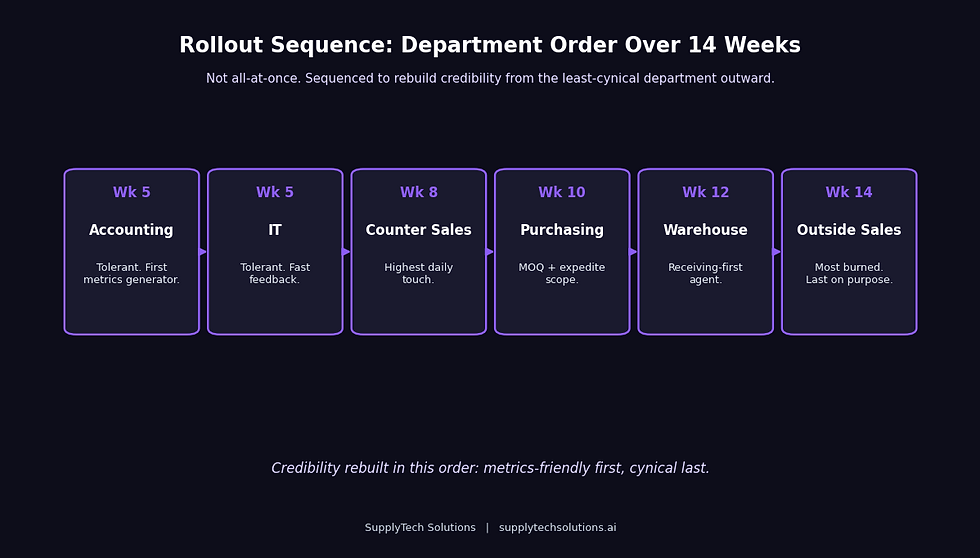
We ran the sequencing to earn credibility back, department by department. Order matters. We started with accounting and IT because they are the two departments most tolerant of imperfect tools and most helpful in producing the metrics leadership needs to see. Their agents went live in week 5. They generated the first internal case study, which we wrote up in one page and circulated. Counter sales went live in week 8, deliberately after we had two weeks of "accounting used it 340 times" data to show. Purchasing came in week 10, warehouse in week 12, outside sales last in week 14 because outside sales was the department most burned by the ChatGPT experiment and the most cynical.
That order is not accidental. AI adoption in mid-market is a sequencing problem more than a technology problem. Every distributor's departments have different tolerance for a beta tool and different political weight. Getting the order wrong on a 14-week engagement is more expensive than getting the model choice wrong.
The Stack Under the Surface
The user surface was Microsoft 365. Copilot Studio agents inside Teams, a Power App for the quote assistant, and one shared SharePoint hub. That was deliberate. Every user already logged into Teams every morning. We did not ask them to open a new app.

Under that surface, four layers. The system of record layer was Prophet 21 read through a nightly ODBC pull into Microsoft Fabric plus a set of live web service calls for anything that needed to be real-time. The data layer was a lakehouse in Fabric with a small semantic model on top. The content layer was SharePoint, cleaned per track one. The agent layer was Copilot Studio, one agent per department, each grounded strictly on the SharePoint site scoped to that department. We wrote a two-page governance policy that said what could and could not be added to any agent's grounding. That two-page document did more for adoption than any model tuning did.
We did not build a cross-departmental orchestrator agent. We considered it. We decided against it because the failure mode of an orchestrator during an adoption effort is confusing users about which agent to trust, and confused users stop using the tool.
We also did not enable any write-back to Prophet 21 from any Copilot agent. The only write-back path was the Power Automate flow behind the quote assistant, and that flow required a salesperson's approval click. Read-only agents, one write path, one human approval gate. Simple. Auditable.
What We Measured, and What the Numbers Looked Like
Adoption is the metric that ate the engagement. We instrumented weekly active use by eligible user in each department and reviewed it every Friday with the client's operations lead.

By week 14, weekly active use across the six live departments sat at roughly 68% of eligible users, with counter sales at 78% and outside sales at 41%. Outside sales was the drag, as expected. First-stop use, meaning the user opened the department agent before calling a coworker or opening SharePoint themselves, was 79% in accounting and IT and 62% in counter sales.
Automation coverage, measured as the share of eligible questions the agent handled without escalation, landed between 35% and 45% depending on department. Team-level admin time eliminated came in at roughly 10 to 18 hours per week across the six departments combined, based on time studies the client's operations lead ran in weeks 12 and 13.
The quote assistant, the only custom tool we shipped, drafted 217 quotes in its first four live weeks, of which 194 were sent to the customer with edits taking under three minutes each. Average quote turnaround on standard SKUs dropped from roughly 2.4 days to under 4 hours. That number is a client-provided measurement, not a modeled projection.
Onboarding time for new counter sales hires improved by roughly 10 to 20%, measured on a small cohort of 4 new hires who came through in weeks 10 through 14. Small sample, hedged number. Worth reporting because it is real, not worth overclaiming.
We did not measure model accuracy. We measured whether the tools got used and whether the work got done.
The Handoff
At week 14, we handed the operating structure to one person on the client side, an operations lead who had been embedded on our team since week 2. She had built two of the six department agents herself in weeks 9 through 13. The IT lead had built the Power Automate flow behind the quote assistant with our shadow supervision. On the way out, we wrote a one-page runbook per agent, a maintenance calendar, and a decision tree for what to do when an agent starts drifting.
Six weeks after handoff, weekly active use had held above 65% and the operations lead had launched a seventh department agent, for warehouse receiving, on her own.
What This Says About AI Adoption in Mid-Market
AI adoption in mid-market is a content and sequencing problem that looks like a technology problem. The technology is available. The models are good enough. The gap is in three places: whether the content the agents ground on is trustworthy, whether the tools are scoped tight enough to answer without embarrassing users, and whether the rollout order gives the political system time to build back the credibility that the last two attempts spent.
Distributors in the $150M to $500M range keep asking us for the tool that fixes this. The tool is not the fix. The pattern is: cleanup, scoped agents, one custom tool, sequenced by department, handed to one person on their side. That pattern moves the adoption number. Every other number follows.
If you are running a specialty hardware distributor, an industrial parts distributor, or a building supply distributor in the same revenue band, the shape of the problem is close enough that the sequence transfers. The names change. The order does not.


Comments